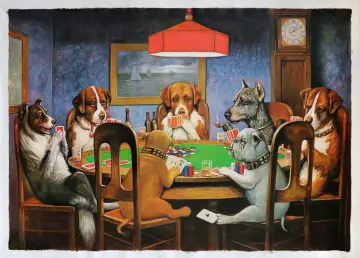
A Friend in Need
1903
♠ Poker A Brooklyn calendar illustrator, a forgotten ad agency in St. Paul, and a series of oil paintings that ended up taped to ten million basement walls. The complete Coolidge canon, the story behind it, and where to actually buy a reproduction worth hanging.
Coolidge painted sixteen dog-society tableaux for Brown & Bigelow between 1903 and 1910. Nine of them sat around a card table. The other seven did everything else dogs in waistcoats might do.
We show below the 6 paintings with high-resolution public-domain scans currently available. The remaining 10 are listed by title on the series page — they are also public domain, but their high-res scans live in the Brown & Bigelow corporate archive and auction-house catalogues, not yet in open archives. We do not generate AI substitutes.
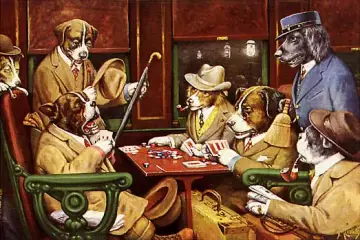
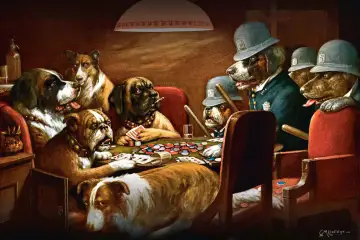
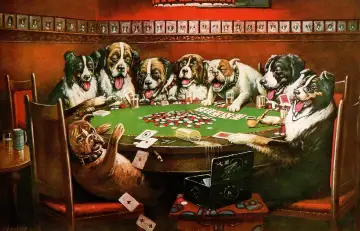
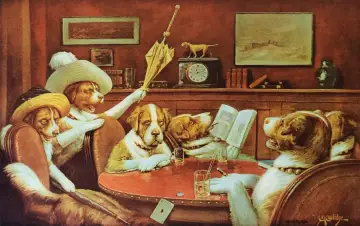
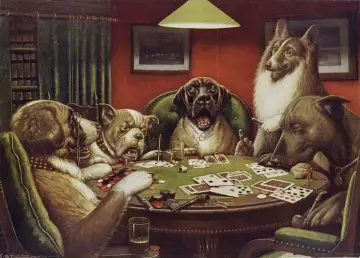
Cassius Marcellus Coolidge was born in 1844 in upstate New York, the son of Quaker abolitionist farmers. By the time he settled in Brooklyn in his late fifties, he had already invented "comic foregrounds" — the boardwalk photo stand where you stick your face through a painted hole — and edited a small-town newspaper. He was, in the truest sense, a hustler of low culture.
In 1903 the calendar printer Brown & Bigelow of St. Paul, Minnesota, commissioned sixteen oil paintings of dogs in human situations to be reproduced on advertising calendars sent to cigar shops, garages, and barbershops across the country. Nine of those paintings sat around a card table. The series ran for seven years.
Coolidge died in 1934 having earned, in total, somewhere around $10,000 for the work. The paintings were not considered art. They were considered calendar art — which, in 1903, was a slur. A century later they have outsold most of his contemporaries on every measure that does not appear in an academic catalog raisonné.
We round up the reproductions worth the money — framed, unframed, canvas, paper. Below: four starter picks from the major retailers. The full comparison lives on the prints page.
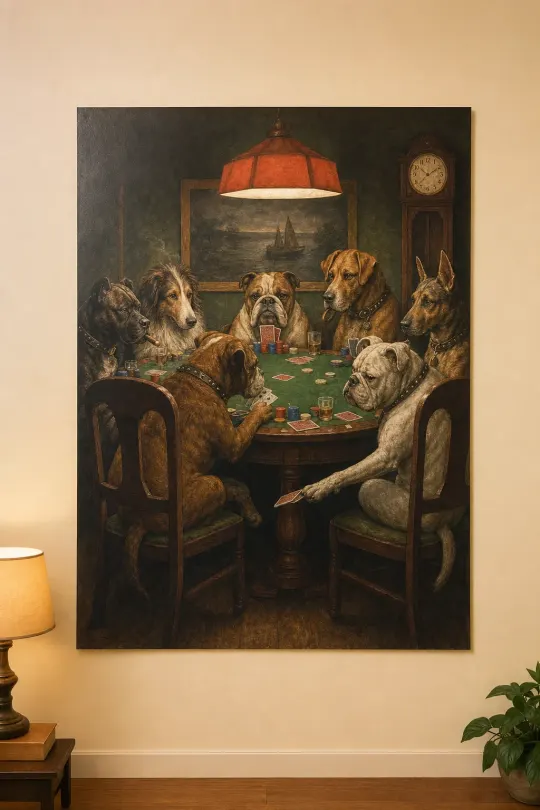
Unframed poster, photo paper. The default reproduction.
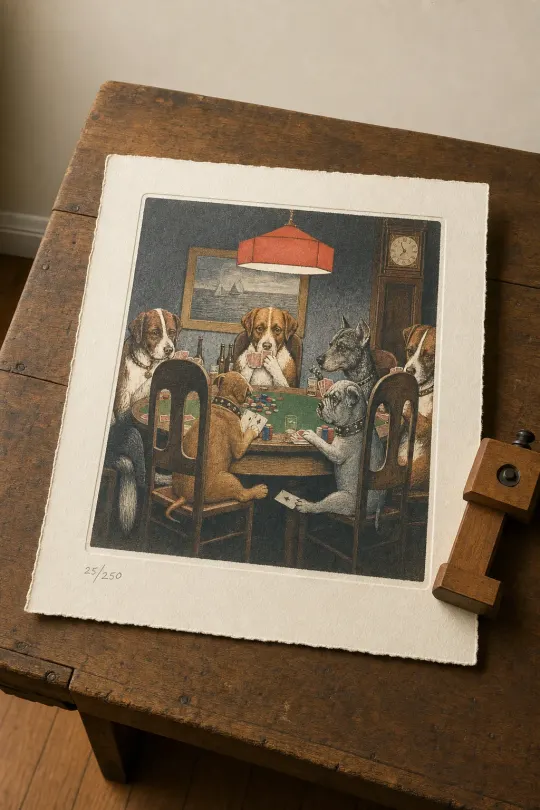
Three-color letterpress on Crane Lettra cotton. Run of 100.
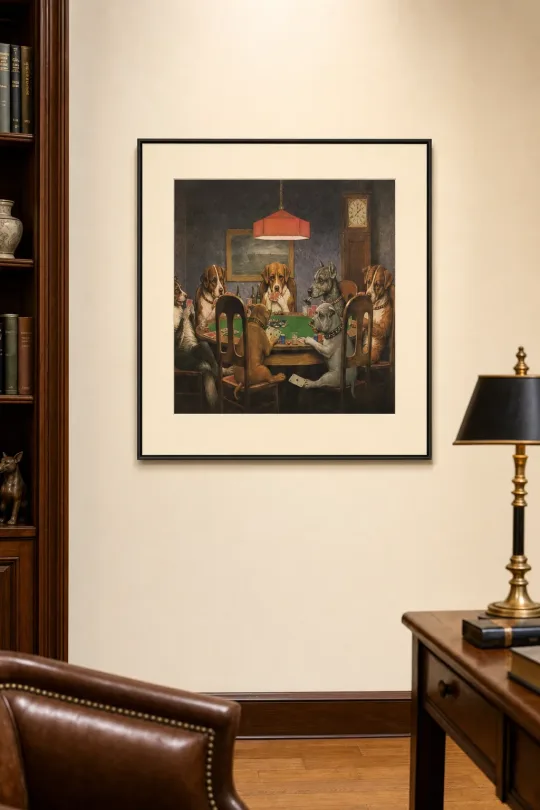
Thin black frame, matted. The classic den-wall option.
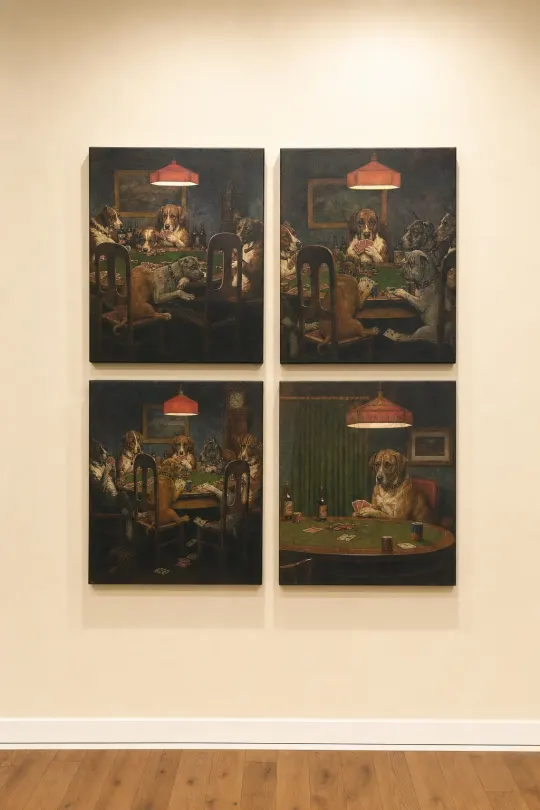
The four most-recognized poker paintings, 16×20 canvas each.
Our sister project commissions custom portraits in the Coolidge tradition — your dog at a felt-table tableau, your call on the suit of cards, AI-rendered and reviewed by hand. Built for the gift, the den wall, the inside joke that has been brewing since 1903.
Commission a Custom Portrait →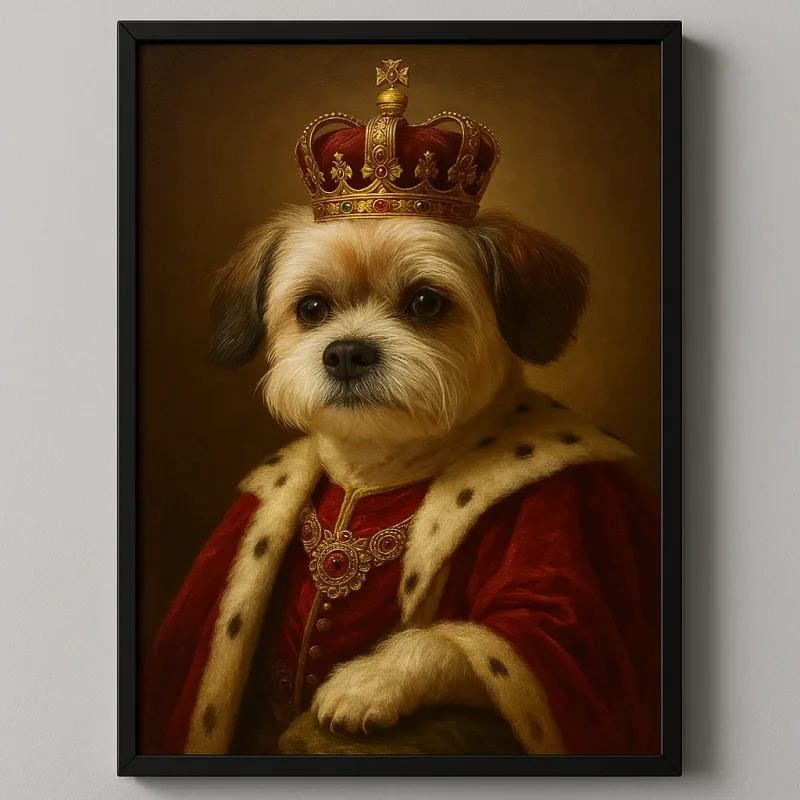
Sixteen oils total in the Brown & Bigelow commission of 1903–1910. Nine of them are set at a card table. The other seven show dogs in court, at a lodge meeting, on a baseball field, at a New Year's Eve dance, broken down on a country road, camping, and at a parlor reunion. Coolidge painted other dog-themed works before and after, but only this run of sixteen is "the series."
Yes. All sixteen Brown & Bigelow paintings were published before 1929 in the United States, which places them firmly in the public domain. You can reproduce them, print them, frame them, put them on a t-shirt.
A Friend in Need (1903) is the one almost everyone means. It is the painting with the bulldog passing an ace under the table to the other bulldog. His Station and Four Aces, A Bold Bluff, and A Waterloo round out the recognizable poker quartet.
Mostly in private collections. Two of the series — A Bold Bluff and A Waterloo — sold together at Sotheby's in 2005 for $590,400. Several others have appeared at Bonhams and Heritage Auctions over the last two decades. The Brown & Bigelow corporate collection in St. Paul still holds a handful.
No. This is an independent editorial site about a public-domain body of work. The Coolidge estate has not endorsed this project and we don't represent ourselves as having any connection to the family.
When you buy a print through a link on this site, we may earn a small commission from the retailer. It costs you nothing extra. We pick the products we would buy ourselves and we do not take money from sellers to feature their reproductions.
Dogplayingpoker.com participates in affiliate programs with Amazon Associates, Etsy, AllPosters, and Wayfair. We earn a commission on qualifying purchases at no additional cost to you. We do not accept payment from sellers to feature products. All editorial selections are independent.